
Civil engineering is one of the oldest and most respected professions in the world. Every road, bridge, building, dam, airport, and metro project depends on the expertise of civil engineers. However, succeeding in this field requires much more than earning a degree.
Modern civil engineers are expected to possess technical knowledge, practical site experience, leadership skills, and the ability to solve real-world problems. Whether you are a civil engineering student, a fresher, or an experienced site engineer, mastering these essential skills will help you build a successful career.
1. Strong Technical Knowledge
A civil engineer must understand the core subjects of civil engineering, including:
- Structural Engineering
- Geotechnical Engineering
- Concrete Technology
- Surveying
- Transportation Engineering
- Construction Materials
Technical knowledge enables engineers to make safe, economical, and durable construction decisions.
2. Ability to Read Construction Drawings
Construction drawings are the language of every project.
A professional civil engineer should know how to read:
- Architectural Drawings
- Structural Drawings
- Reinforcement Drawings
- Foundation Drawings
- MEP Drawings
Reading drawings correctly reduces mistakes, prevents rework, and improves project quality.
3. Knowledge of Construction Materials
Every civil engineer should understand the properties and applications of:
- Cement
- Steel
- Sand
- Aggregates
- Concrete
- Bricks
- Blocks
- Admixtures
Selecting the right material improves the strength, durability, and cost-effectiveness of a project.
4. Site Management Skills
A site engineer is responsible for ensuring that work is completed safely, on time, and within budget.
Key responsibilities include:
- Labour management
- Material planning
- Daily work scheduling
- Equipment coordination
- Contractor supervision
- Progress monitoring
Good planning minimizes delays and improves productivity.
5. Quality Control
Quality is the foundation of every successful construction project.
Civil engineers should know how to perform:
- Slump Test
- Cube Compression Test
- Material Inspection
- Reinforcement Checking
- Concrete Pour Inspection
Maintaining quality at every stage prevents costly repairs in the future.
6. Construction Safety
Safety is everyone’s responsibility.
Every engineer should ensure:
- Proper PPE usage
- Safe scaffolding
- Excavation safety
- Electrical safety
- Lifting operation safety
- Daily toolbox talks
A safe construction site protects workers and improves project efficiency.
7. Quantity Estimation and Billing
A civil engineer should know how to calculate:
- Concrete quantity
- Brickwork quantity
- Steel quantity
- Earthwork quantity
- Plaster quantity
- BOQ preparation
- Contractor billing
Estimation skills help control project costs and improve profitability.
8. Software Skills
Today’s civil engineers should be familiar with:
- AutoCAD
- Revit
- STAAD.Pro
- Primavera P6
- Microsoft Excel
- MS Project
Software knowledge increases productivity and career opportunities.
9. Communication and Leadership
Civil engineers coordinate with clients, consultants, contractors, architects, and workers.
Good communication helps:
- Resolve site issues
- Improve teamwork
- Avoid misunderstandings
- Increase project efficiency
Leadership is essential for managing teams and achieving project goals.
10. Continuous Learning
Construction technology evolves every year.
Stay updated by:
- Reading IS Codes
- Learning new software
- Attending workshops
- Following construction standards
- Reading technical blogs
Continuous learning keeps you competitive in the industry.
Essential Skills Summary
| Skill | Why It Matters |
|---|---|
| Technical Knowledge | Strong engineering fundamentals |
| Drawing Reading | Accurate construction execution |
| Construction Materials | Better quality and durability |
| Site Management | Timely project completion |
| Quality Control | Defect-free construction |
| Safety | Protects workers and project |
| Estimation | Controls project costs |
| Software Skills | Improves productivity |
| Communication | Better teamwork |
| Continuous Learning | Career growth |
Civil Engineer Skill Development Roadmap
Engineering Basics
        ↓
Technical Knowledge
        ↓
Drawing Reading
        ↓
Site Execution
        ↓
Quality Control
        ↓
Safety Management
        ↓
Quantity Estimation
        ↓
Software Skills
        ↓
Leadership
        ↓
Professional Civil Engineer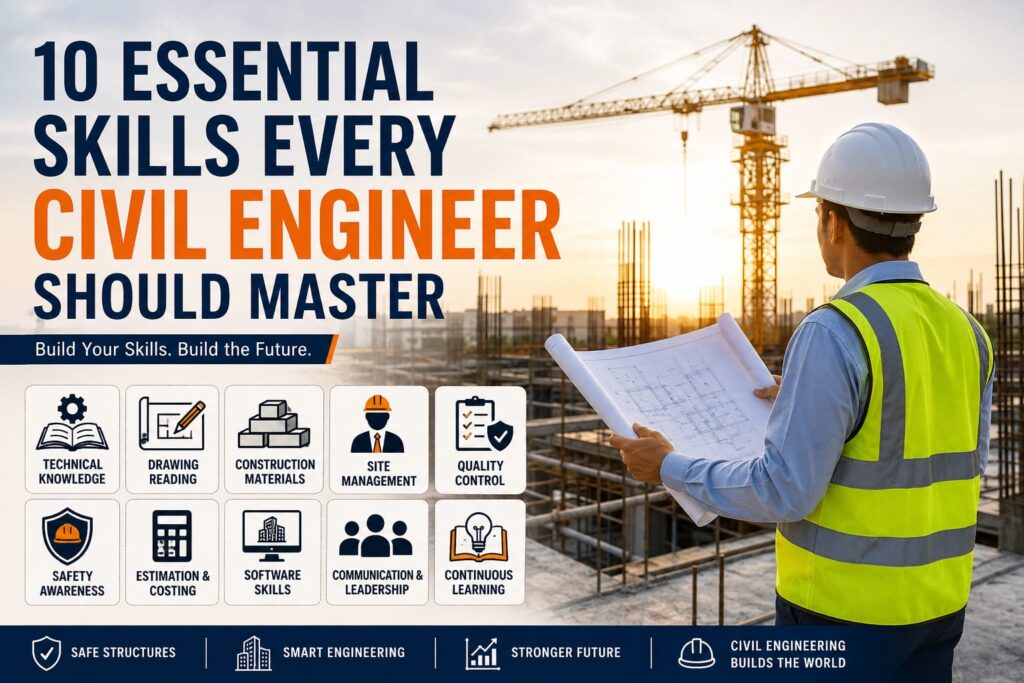
Conclusion
A successful civil engineer combines technical expertise, practical experience, leadership, and continuous learning. By mastering these ten essential skills, you can confidently handle construction projects, improve quality, ensure safety, and build a rewarding career in the construction industry.
Remember, great engineers are not made overnight. Every project you work on is an opportunity to learn something new.
V good sir
Pingback: Responsibilities of a Site Engineer Explained: Roles, Duties, Skills, and Daily Work - Civil Construction Hub
Pingback: DeepLok PMC & Contracts Recruitment 2026 | Project Manager, Site Engineer, Safety Officer & More | Apply Now - Civil Construction Hub
Pingback: Chavda Infra Ltd Recruitment 2026 | Civil Engineer, Site Engineer, Billing & Quantity and Store Incharge Jobs in Ahmedabad - Civil Construction Hub