
Difference Between OPC and PPC Cement | Complete Guide for Civil Engineers, Contractors & Home Builders
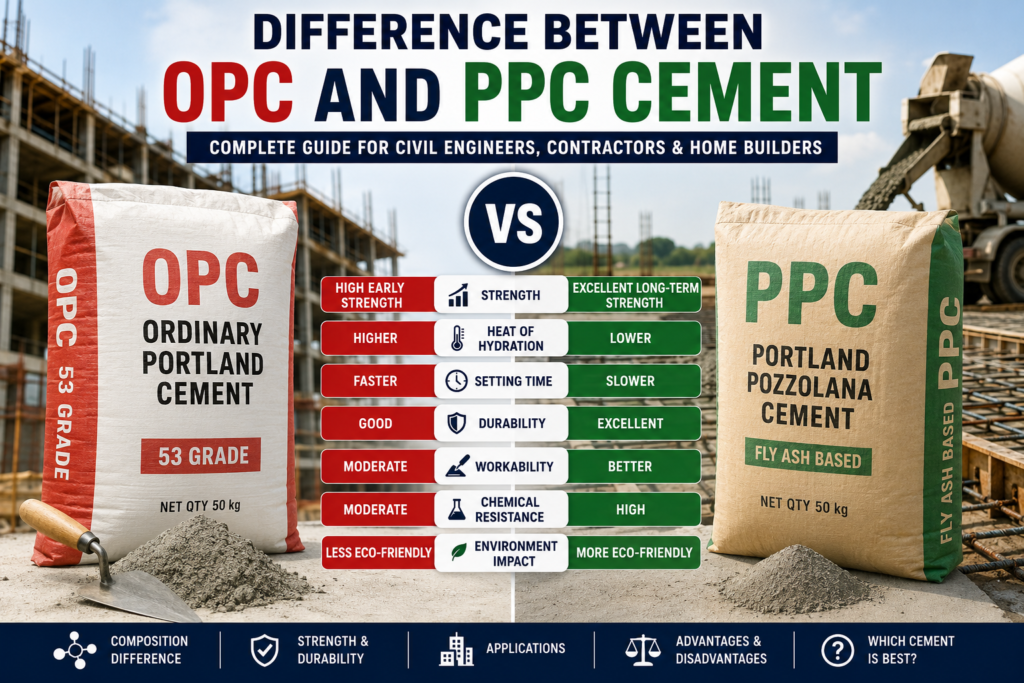
Introduction
Cement is one of the most essential construction materials used in almost every type of infrastructure project, from residential houses to highways, bridges, industrial plants, commercial buildings, and dams. Selecting the right type of cement directly affects the strength, durability, workability, and lifespan of a structure. OPC and PPC
Among the many types of cement available in India, Ordinary Portland Cement (OPC) and Portland Pozzolana Cement (PPC) are the two most widely used. Although both are manufactured according to quality standards and are suitable for construction, they differ significantly in composition, strength development, setting time, heat of hydration, durability, and ideal applications.
Many homeowners, civil engineers, contractors, and construction professionals often ask, “Which cement is better, OPC or PPC?” The answer depends on the type of project, environmental conditions, construction schedule, and performance requirements.
In this detailed guide, we’ll compare OPC and PPC cement in depth to help you make the right choice for your next construction project.
- Responsibilities of a Site Engineer Explained: Roles, Duties, Skills, and Daily Work
- DeepLok PMC & Contracts Recruitment 2026
- PNC Infratech Ltd Recruitment 2026
- Types of Foundations in Building Construction | Complete Guide.
- Chavda Infra Ltd Recruitment 2026
- Bhilai Engineering & Consultancy Services Recruitment 2026
- Balajee Infratech & Constructions Recruitment 2026
What is OPC Cement?
Ordinary Portland Cement (OPC) is the most common type of cement used worldwide. It is manufactured by grinding clinker with a small quantity of gypsum to regulate the setting time.
OPC is known for its high early strength, making it suitable for projects that require quick construction and faster formwork removal.
Key Features of OPC
- High early compressive strength
- Faster setting compared to PPC
- Suitable for heavy structural works
- Available in 33, 43, and 53 grades
- Widely used in RCC construction
What is PPC Cement?
Portland Pozzolana Cement (PPC) is produced by blending Ordinary Portland Cement clinker with pozzolanic materials such as fly ash, volcanic ash, calcined clay, or silica-rich materials.
The pozzolanic material reacts with calcium hydroxide released during cement hydration, producing additional cementitious compounds that improve long-term strength and durability.
Follow Us
Key Features of PPC
- Better durability
- Lower heat generation
- Improved workability
- Excellent resistance to chemical attack
- Eco-friendly due to fly ash utilization
Main Difference Between OPC and PPC Cement
| Feature | OPC Cement | PPC Cement |
| Full Form | Ordinary Portland Cement | Portland Pozzolana Cement |
| Composition | Clinker + Gypsum | Clinker + Gypsum + Pozzolanic Material |
| Early Strength | High | Moderate |
| Long-Term Strength | Good | Excellent |
| Heat of Hydration | Higher | Lower |
| Setting Time | Faster | Slightly Slower |
| Durability | Good | Excellent |
| Crack Resistance | Moderate | Better |
| Workability | Moderate | Better |
| Chemical Resistance | Moderate | High |
| Cost | Slightly Higher | Usually More Economical |
| Environmental Impact | Higher | Lower |
Manufacturing Difference
OPC Manufacturing
The manufacturing process includes:
- Limestone crushing
- Clinker production
- Grinding clinker
- Addition of gypsum
- Packaging
No pozzolanic material is added.
PPC Manufacturing
The initial manufacturing process is similar to OPC, but pozzolanic materials such as fly ash are blended before grinding and packaging.
This improves durability and sustainability.
Grades Available
OPC Grades
OPC is available in three grades:
- OPC 33 Grade
- OPC 43 Grade
- OPC 53 Grade
The grade indicates the minimum compressive strength achieved after 28 days.
PPC
PPC is generally supplied as a single category meeting prescribed strength requirements, without separate 33/43/53 grade classifications.
Strength Comparison
One of the biggest differences between OPC and PPC is how strength develops over time.
OPC
- Gains strength rapidly during the first week.
- Ideal where early loading is required.
- Suitable for fast-track projects.
PPC
- Gains strength more gradually.
- Achieves excellent long-term strength.
- Produces denser concrete over time.
Setting Time
OPC
- Initial Setting Time: About 30 minutes
- Final Setting Time: Around 10 hours
PPC
- Slightly slower setting.
- Provides more working time.
- Better for large concrete pours.
Heat of Hydration
Heat generated during cement hydration affects cracking in large concrete members.
OPC
Produces more heat.
Suitable for:
- Columns
- Beams
- Slabs
- Small foundations
PPC
Produces less heat.
Suitable for:
- Raft foundations
- Mass concreting
- Dams
- Large footings
- Thick retaining walls
Durability
PPC performs better in aggressive environments because its denser microstructure reduces permeability.
OPC
Good durability under normal conditions.
PPC
Excellent resistance to:
- Sulphate attack
- Chloride penetration
- Moisture ingress
- Alkali reactions
Workability
Concrete made with PPC is generally more workable due to finer particles and pozzolanic content.
Benefits include:
- Easier placement
- Better finishing
- Reduced segregation
- Improved pumpability
Crack Resistance
OPC develops higher early heat, increasing the possibility of thermal cracking in large pours.
PPC’s lower heat evolution reduces shrinkage and cracking, making it suitable for durable concrete structures.
Curing Requirement
Both OPC and PPC require proper curing.
However, PPC benefits greatly from extended curing because the pozzolanic reaction continues for a longer period, resulting in higher long-term strength.
Environmental Impact
PPC is considered more environmentally friendly because:
- Fly ash is recycled.
- Less clinker is required.
- Carbon emissions are reduced.
- Industrial waste is effectively utilized.
This makes PPC a preferred choice for sustainable construction.
Applications of OPC Cement
OPC is commonly used for:
- RCC buildings
- High-rise structures
- Bridges
- Industrial foundations
- Roads
- Precast concrete
- Prestressed concrete
- Fast-track construction
Applications of PPC Cement
PPC is ideal for:
- Residential buildings
- Plastering
- Masonry work
- Marine structures
- Water tanks
- Sewage treatment plants
- Dams
- Foundations
- Mass concreting
- Coastal construction
Advantages of OPC Cement
- High early strength
- Faster construction
- Quick formwork removal
- Excellent for RCC
- Reliable performance
- Suitable for heavy structural loads
Disadvantages
- Higher heat generation
- Greater shrinkage risk
- Slightly lower chemical resistance
- Less eco-friendly
Advantages of PPC Cement
- Better durability
- Lower heat of hydration
- Improved workability
- Better resistance to sulphates
- Reduced cracking
- Long-term strength gain
- Environmentally friendly
Disadvantages
- Slower early strength gain
- Longer curing recommended
- Slightly slower construction in fast-track projects
Which Cement is Better?
The choice depends on project requirements.
Choose OPC if:
- Early strength is critical.
- Construction must progress quickly.
- Heavy structural members are involved.
- Precast elements are being produced.
Choose PPC if:
- Long-term durability is important.
- The structure is exposed to moisture or chemicals.
- Mass concreting is involved.
- Sustainability is a priority.
Common Mistakes When Choosing Cement
Avoid these common errors:
- Selecting cement based only on price.
- Ignoring environmental conditions.
- Using OPC for large mass concrete without considering heat generation.
- Neglecting proper curing.
- Mixing different cement types without engineering guidance.
- Buying cement stored in damp conditions.
Storage Tips
To maintain cement quality:
- Store in a dry, covered area.
- Keep bags on wooden pallets.
- Protect from moisture.
- Use older stock first.
- Avoid stacking bags too high.
- Seal opened bags properly.
Frequently Asked Questions (FAQs)
Is PPC stronger than OPC?
OPC develops higher early strength, while PPC generally provides superior long-term strength and durability.
Which cement is best for house construction?
For most residential projects, PPC is an excellent choice due to its durability and workability. However, OPC may be preferred where rapid strength gain is required.
Can OPC and PPC be used together?
It is generally better to use one cement type consistently for a project unless an engineer specifies otherwise.
Which cement is better for plastering?
PPC is widely preferred because it offers smoother finishing, better workability, and reduced cracking.
Which cement is better for RCC?
Both can be used successfully. OPC is often selected for faster strength development, while PPC is favored for durable RCC in aggressive environments.
- Responsibilities of a Site Engineer Explained: Roles, Duties, Skills, and Daily Work
- DeepLok PMC & Contracts Recruitment 2026
- PNC Infratech Ltd Recruitment 2026
- Types of Foundations in Building Construction | Complete Guide.
- Chavda Infra Ltd Recruitment 2026
- Bhilai Engineering & Consultancy Services Recruitment 2026
- Balajee Infratech & Constructions Recruitment 2026
Conclusion
Both Ordinary Portland Cement (OPC) and Portland Pozzolana Cement (PPC) play vital roles in modern construction. OPC is the preferred option when high early strength and rapid project execution are required, while PPC excels in durability, long-term performance, crack resistance, and sustainability.
There is no universal “best” cement. The right choice depends on the structural design, project timeline, exposure conditions, and engineering requirements. Understanding the differences between OPC and PPC allows builders, contractors, and homeowners to make informed decisions that improve the quality, safety, and lifespan of their structures. OPC and PPC
Whether you are constructing a home, a commercial building, a bridge, or an industrial facility, choosing the appropriate cement is one of the most important decisions in ensuring long-lasting performance. OPC and PPC