
Types of Foundations in Building Construction
Foundation is the most important structural component of any building. It forms the base that transfers the load of the structure safely to the ground. A well-designed foundation ensures the stability, durability, and safety of a building throughout its service life.
Selecting the right type of foundation depends on several factors, including soil conditions, building loads, groundwater level, seismic considerations, construction cost, and site constraints.
In this detailed guide, you’ll learn about the different types of foundations used in building construction, their applications, advantages, disadvantages, and selection criteria.


Follow Us
What is a Foundation?
A foundation is the lowest part of a structure that transfers the loads from the building safely to the supporting soil or rock.
Types of Foundations in Building Construction
Its primary purpose is to:
- Support the entire building
- Transfer structural loads safely
- Prevent differential settlement
- Improve structural stability
- Resist lateral loads such as wind and earthquakes
- Protect against soil movement and moisture
Functions of Foundation
The major functions of a foundation include:
- Safely distribute structural loads
- Prevent excessive settlement
- Increase structural stability
- Prevent sliding and overturning
- Protect against frost action
- Resist uplift forces
- Provide a level base for construction
Classification of Foundations
Foundations are broadly classified into two categories.
| Foundation Type | Suitable Depth | Typical Application |
| Shallow Foundation | Up to about 3 m | Low-rise buildings |
| Deep Foundation | Greater than 3 m | High-rise buildings, bridges, heavy structures |
Types of Foundations
Types of Shallow Foundations
Shallow foundations are used when the soil near the ground surface has sufficient bearing capacity.
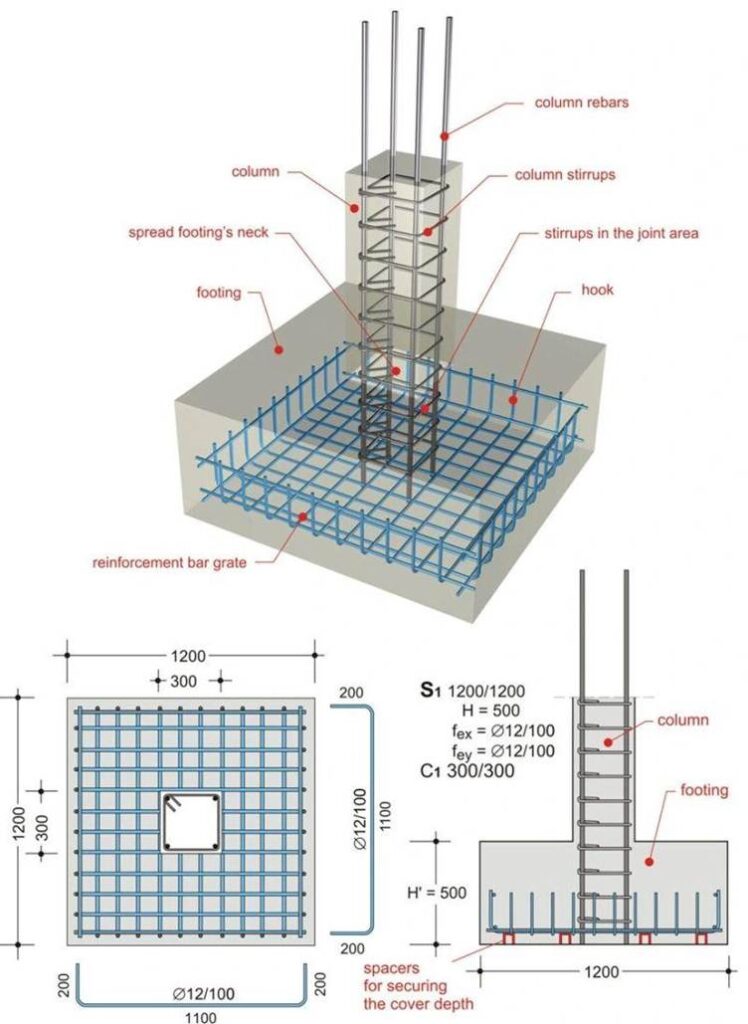
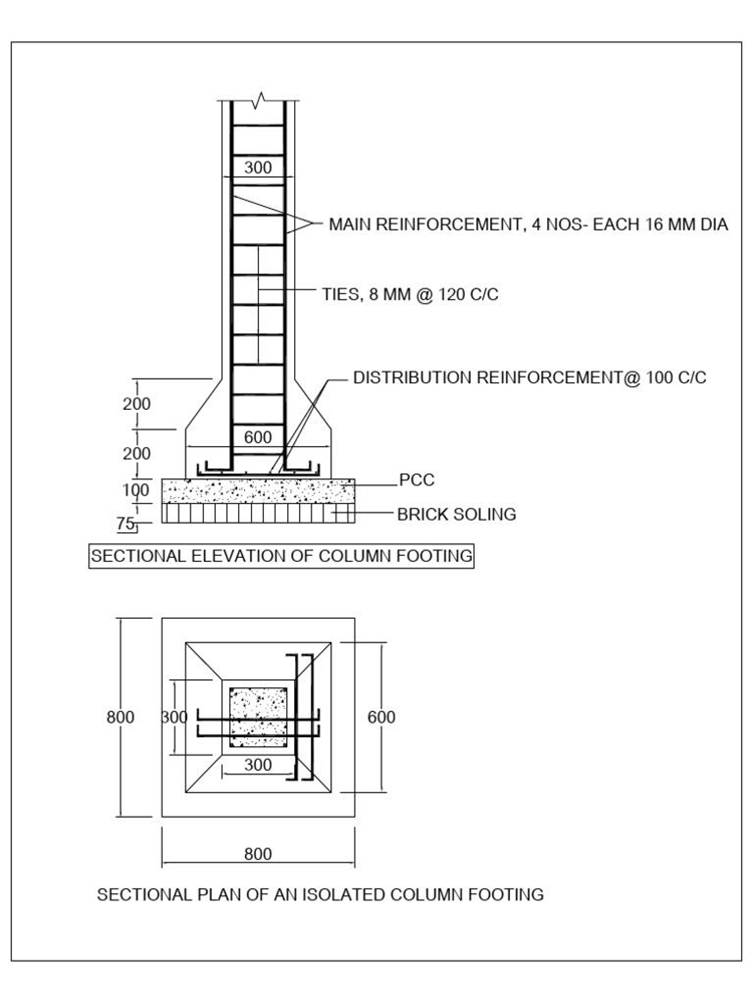
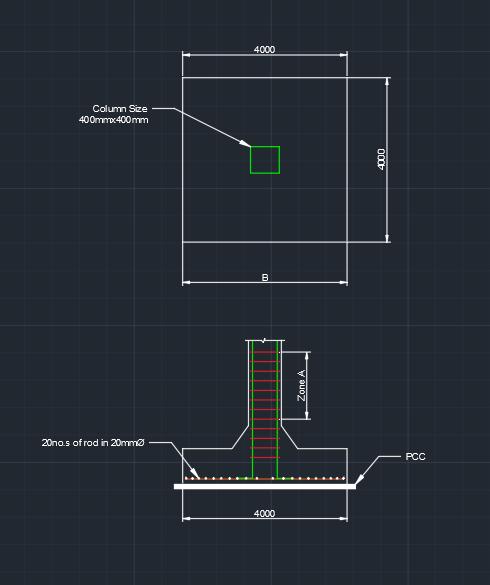
1. Isolated Footing
4
An isolated footing supports a single column and is one of the most commonly used foundations in residential and commercial buildings.
Suitable For
- Individual RCC columns
- Low-rise buildings
- Strong soil conditions
Advantages
- Economical
- Easy to construct
- Requires less excavation
- Faster construction
Disadvantages
- Not suitable for weak soil
- Unsuitable for closely spaced columns
Typical Shape
- Square
- Rectangular
- Circular
- Stepped footing
2. Combined Footing
A combined footing supports two or more columns using a single footing.
Used When
- Columns are close together
- Property line restrictions exist
- Individual footings overlap
Advantages
- Uniform load distribution
- Cost-effective
- Suitable near property boundaries
Disadvantages
- More reinforcement required
- Complex design
3. Strap Footing
A strap footing consists of two isolated footings connected by a reinforced concrete beam called a strap beam.
Applications
- Edge columns
- Boundary walls
- Limited construction space
Advantages
- Prevents eccentric loading
- Economical solution
- Improves stability
Limitations
- Not suitable for weak soil
- Design requires careful analysis
4. Strip Footing
Strip footing is a continuous footing that supports load-bearing walls.
Common Uses
- Masonry structures
- Compound walls
- Residential houses
Advantages
- Simple construction
- Low cost
- Uniform load transfer
Disadvantages
- Not suitable for heavy structures
- Limited application in poor soil
5. Raft (Mat) Foundation
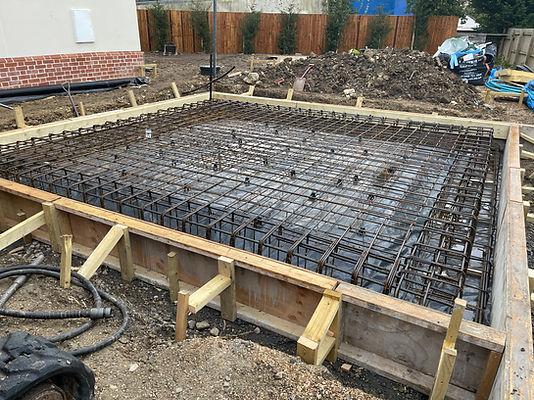
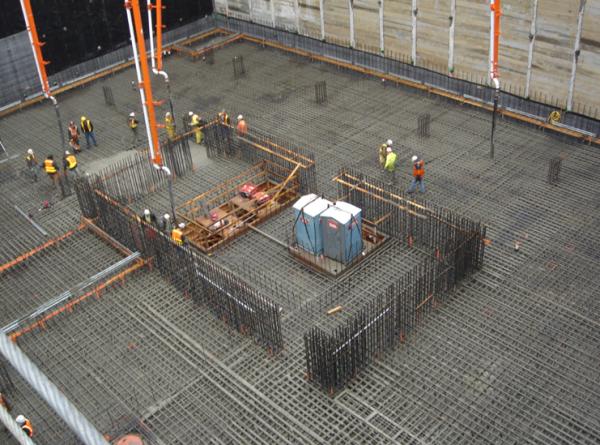
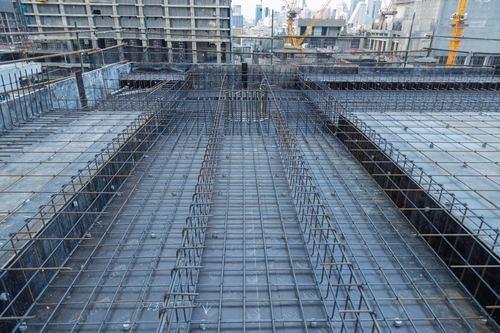
A raft foundation is a large reinforced concrete slab supporting the entire building.
Instead of individual footings, one large slab distributes the load over the whole area.
Suitable For
- Soft soil
- High-rise buildings
- Heavy industrial structures
- Basement construction
Advantages
- Reduces differential settlement
- Supports heavy loads
- Excellent for weak soil
- Good earthquake performance
Disadvantages
- High construction cost
- Requires skilled workmanship
- Large quantity of concrete and steel
6. Grillage Foundation
A grillage foundation consists of steel or reinforced concrete beams arranged in layers.
Applications
- Steel columns
- Transmission towers
- Heavy industrial equipment
Advantages
- High load capacity
- Reduces pressure on soil
Disadvantages
- Costly
- Requires corrosion protection
Types of Deep Foundations
Deep foundations transfer structural loads to stronger soil or rock located at greater depths.
1. Pile Foundation
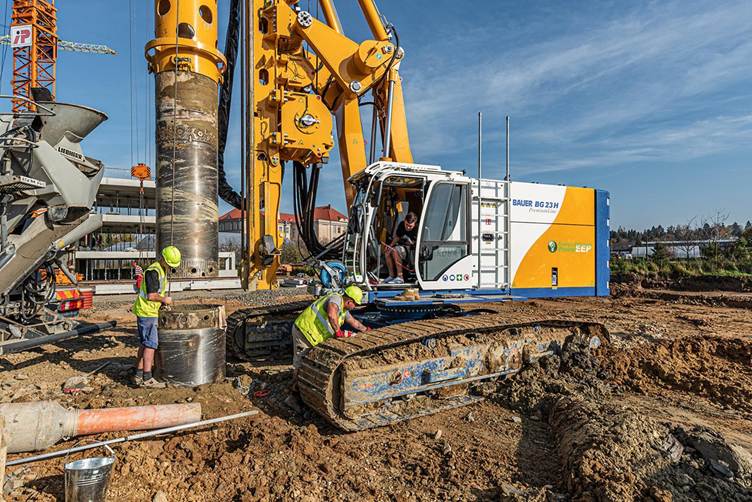
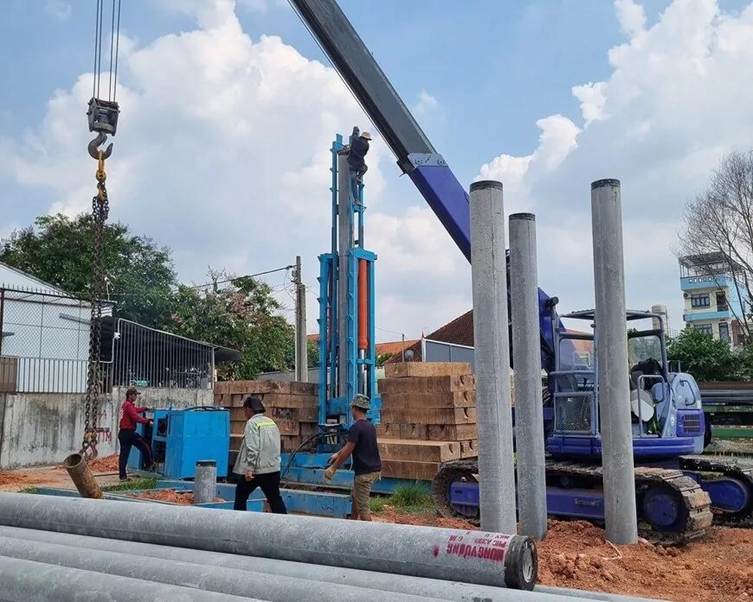
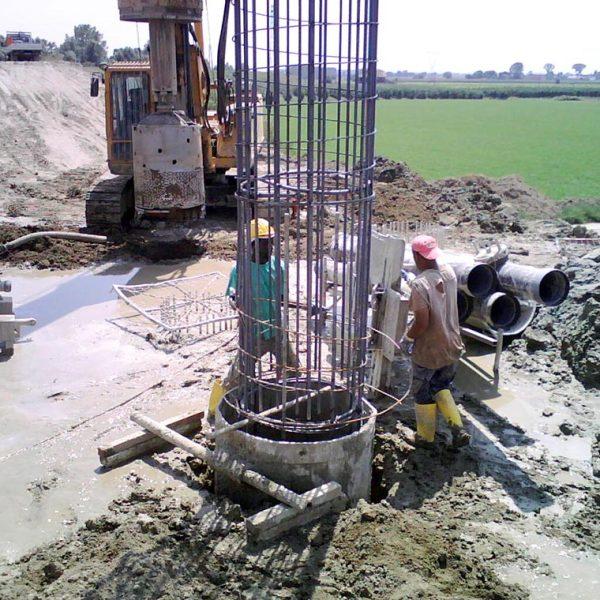
Pile foundations are long slender members driven or bored into the ground.
Loads are transferred through:
- End bearing
- Skin friction
- Combination of both
Types of Piles
Based on Material
- Reinforced Concrete Pile
- Steel Pile
- Timber Pile
- Composite Pile
Based on Installation
- Driven Pile
- Bored Cast-in-Situ Pile
- Screw Pile
Based on Load Transfer
- End Bearing Pile
- Friction Pile
- Combined Pile
Advantages
- Suitable for weak soil
- Supports very heavy loads
- Excellent for waterlogged areas
- Ideal for bridges
Disadvantages
- High construction cost
- Requires specialized equipment
- Noise during driving
2. Pier Foundation
Pier foundations use large diameter cylindrical columns to transfer loads.
Applications
- Bridges
- Elevated structures
- Industrial buildings
Advantages
- High load capacity
- Less vibration than piles
Disadvantages
- Expensive
- Time-consuming
3. Caisson Foundation
Caisson foundations are hollow watertight structures sunk into the ground or underwater.
Common Applications
- River bridges
- Ports
- Dams
- Offshore structures
Advantages
- Suitable underwater
- High stability
Disadvantages
- Very expensive
- Complex construction
Foundation Selection Criteria
Choosing the right foundation depends on several engineering factors.
| Factor | Influence |
| Soil Bearing Capacity | Determines foundation size |
| Building Load | Influences depth and type |
| Groundwater Level | Affects construction method |
| Adjacent Structures | Controls excavation |
| Seismic Zone | Requires earthquake-resistant design |
| Construction Cost | Impacts feasibility |
| Site Conditions | Determines equipment access |
Soil Bearing Capacity and Foundation Selection
| SBC (kN/m²) | Recommended Foundation |
| Above 300 | Isolated Footing |
| 200–300 | Combined Footing |
| 100–200 | Raft Foundation |
| Below 100 | Pile Foundation |
Note: Actual selection should always be based on a detailed geotechnical investigation.
Foundation Construction Process
The general sequence of foundation construction includes:
- Site survey
- Soil investigation
- Setting out
- Excavation
- PCC (Plain Cement Concrete)
- Reinforcement placement
- Formwork
- Concrete pouring
- Curing
- Backfilling
- Compaction
Common Foundation Failures
Poor construction or improper design can lead to foundation failures.
Common Problems
- Differential settlement
- Foundation cracks
- Soil erosion
- Water seepage
- Excessive settlement
- Tilting
- Structural instability
Causes
- Poor soil investigation
- Low-quality concrete
- Improper reinforcement
- Inadequate drainage
- Overloading
- Poor workmanship
Best Practices for Foundation Construction
To ensure a durable and safe foundation:
- Conduct a thorough soil investigation before design.
- Select the foundation type based on geotechnical and structural requirements.
- Use high-quality concrete and reinforcement.
- Maintain proper concrete cover to protect steel from corrosion.
- Ensure accurate excavation dimensions and levels.
- Provide effective drainage to prevent water accumulation.
- Follow approved structural drawings and specifications.
- Cure concrete adequately to achieve the required strength.
- Inspect reinforcement, formwork, and footing levels before concreting.
- Perform quality control tests on materials and concrete during construction.
Comparison of Foundation Types
| Foundation Type | Cost | Load Capacity | Suitable Soil | Construction Speed |
| Isolated Footing | Low | Medium | Strong Soil | Fast |
| Combined Footing | Medium | Medium | Medium Soil | Moderate |
| Strip Footing | Low | Medium | Good Soil | Fast |
| Strap Footing | Medium | Medium | Good Soil | Moderate |
| Raft Foundation | High | High | Weak Soil | Moderate |
| Pile Foundation | Very High | Very High | Very Weak Soil | Slow |
| Pier Foundation | High | High | Weak Soil | Slow |
| Caisson Foundation | Very High | Very High | Water Bodies | Slow |
Importance of Soil Investigation
A foundation is only as good as the soil beneath it. Before designing any foundation, a geotechnical investigation should be carried out to determine:
- Soil type and stratification
- Safe Bearing Capacity (SBC)
- Groundwater table
- Settlement characteristics
- Shear strength
- Presence of expansive or collapsible soils
This information enables engineers to choose the safest and most economical foundation system while minimizing the risk of settlement or structural failure.
Frequently Asked Questions (FAQs)
1. Which foundation is best for residential buildings?
For most low-rise residential buildings constructed on good soil, an isolated footing is the most economical and commonly used foundation.
2. What is the difference between shallow and deep foundations?
Shallow foundations transfer loads to soil close to the surface, whereas deep foundations transfer loads to deeper, stronger soil layers or bedrock using elements such as piles or piers.
3. When is a raft foundation preferred?
A raft foundation is preferred when the soil has low bearing capacity, columns are closely spaced, or differential settlement needs to be minimized.
4. Why are pile foundations used?
Pile foundations are used where surface soils are weak, compressible, or waterlogged, and stronger soil or rock is available at greater depths.
5. What factors influence foundation selection?
The key factors include soil bearing capacity, building load, groundwater level, seismic considerations, site conditions, construction cost, and local building regulations.
Conclusion
Foundations are the backbone of every building, ensuring that structural loads are safely transferred to the ground while maintaining stability and durability. The choice between shallow and deep foundations depends on soil conditions, structural requirements, environmental factors, and project budget.
Isolated, strip, combined, and raft foundations are widely used for low- to medium-rise buildings where surface soils are adequate. In contrast, pile, pier, and caisson foundations are essential for heavy structures, high-rise buildings, bridges, and sites with poor soil conditions.
A successful foundation system begins with a detailed soil investigation, careful structural design, and strict quality control during construction. By selecting the appropriate foundation type and following sound engineering practices, civil engineers can ensure long-lasting, safe, and efficient structures.
Suggested Internal Links
Once published, link this article to:
- 10 Essential Skills Every Civil Engineer Should Master
- Responsibilities of a Site Engineer Explained: Roles, Duties, Skills, and Daily Work
- DeepLok PMC & Contracts Recruitment 2026
- PNC Infratech Ltd Recruitment 2026
Call to Action
Enjoyed this guide? Bookmark Civil Construction Hub and subscribe to receive practical civil engineering tutorials, construction site tips, IS Code guides, quantity estimation methods, and career advice for civil engineers.
Pingback: HG Infra Engineering Recruitment 2026: T&D Design, Survey, Liaison & HR Jobs in Gurgaon | Apply Now - Civil Construction Hub
Pingback: Megha Engineering & Infrastructure Limited (MEIL) Hiring 2026: BESS Team Recruitment for Experienced Professionals - Civil Construction Hub