
M20, M25, M30 Concrete Grades Explained: Complete Guide to Mix Ratio, Strength, Uses, and Selection
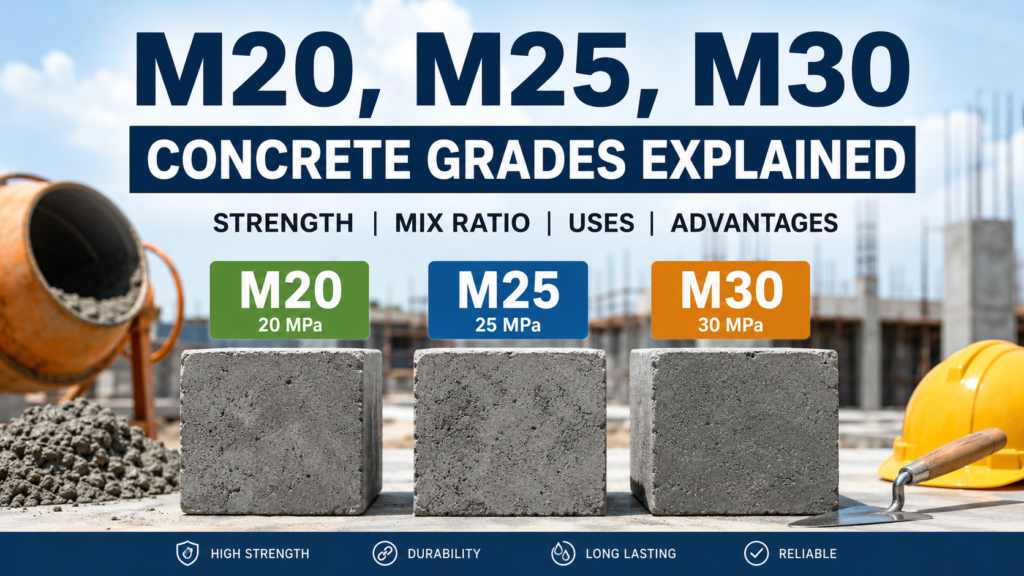
M20, M25, M30 Concrete Grades Explained
Concrete is the backbone of modern construction. Whether you are building a house, commercial complex, bridge, highway, or industrial plant, selecting the correct concrete grade is one of the most important decisions. Different concrete grades provide different levels of compressive strength, durability, and performance.
Among all concrete grades used in India, M20, M25, and M30 are the most common. These grades are widely used in residential buildings, commercial projects, and infrastructure works because they offer an excellent balance of strength, durability, and cost.
In this detailed guide, we will explain everything you need to know about M20, M25, and M30 concrete grades, including their meaning, compressive strength, mix ratio, applications, advantages, disadvantages, and how to choose the right grade for your project.
- Responsibilities of a Site Engineer Explained: Roles, Duties, Skills, and Daily Work
- DeepLok PMC & Contracts Recruitment 2026
- PNC Infratech Ltd Recruitment 2026
- Types of Foundations in Building Construction | Complete Guide.
- Chavda Infra Ltd Recruitment 2026
- Bhilai Engineering & Consultancy Services Recruitment 2026
- Balajee Infratech & Constructions Recruitment 2026
- Difference Between OPC and PPC Cement
- Ahluwalia Contracts (India) Limited Recruitment 2026
- HG Infra Engineering Recruitment 2026
What Does “M” Mean in Concrete Grade?
The letter “M” stands for Mix.
The number following the letter M represents the characteristic compressive strength of concrete measured after 28 days of curing.
For example:
- M20 = 20 MPa (20 N/mm²)
- M25 = 25 MPa
- M30 = 30 MPa
This strength is determined by testing standard concrete cubes in a compression testing machine.
What is Characteristic Strength?
Characteristic strength means the concrete strength achieved by 95% of tested samples after 28 days.
For example:
- M20 concrete should achieve at least 20 MPa
- M25 concrete should achieve at least 25 MPa
- M30 concrete should achieve at least 30 MPa
Understanding Concrete Mix
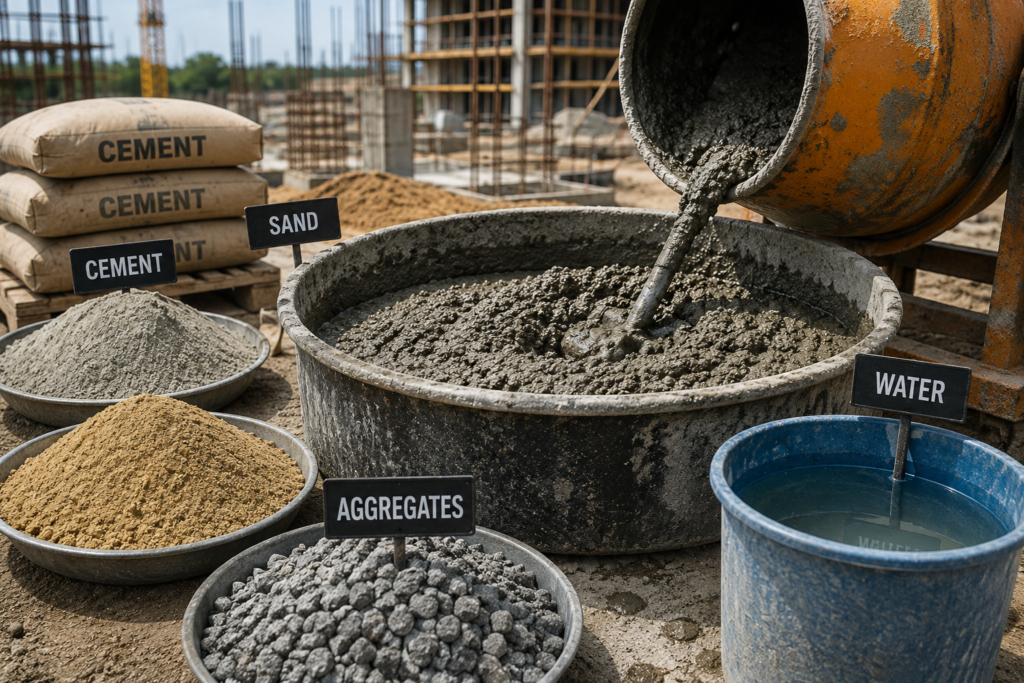
Concrete consists of four basic ingredients:
- Cement
- Fine Aggregate (Sand)
- Coarse Aggregate
- Water
Sometimes additional materials are added such as:
- Fly Ash
- GGBS
- Silica Fume
- Plasticizers
- Superplasticizers
- Waterproofing Chemicals
The proportion of these ingredients determines the concrete grade.
M20 Concrete Grade
Overview
M20 is one of the most commonly used concrete grades in residential construction.
It is generally considered the minimum recommended concrete grade for reinforced cement concrete (RCC) in residential buildings.
Characteristic Strength
20 MPa after 28 days
Nominal Mix Ratio
1 : 1.5 : 3
- Cement = 1
- Sand = 1.5
- Aggregate = 3
Water-cement ratio:
0.45 to 0.60
Applications of M20 Concrete
M20 concrete is suitable for:
- Residential buildings
- House slabs
- Footings
- Beams
- Columns (light load)
- Staircases
- Compound walls
- Pathways
- PCC works
- Floor concrete
Advantages of M20 Concrete
- Economical
- Easy to prepare
- Good workability
- Suitable for most residential structures
- Readily available materials
- Lower construction cost
Limitations
- Not suitable for heavy industrial structures
- Lower durability in aggressive environments
- Lower load-bearing capacity
- Limited resistance against chemicals
Follow Us
M25 Concrete Grade
Overview
M25 is considered a higher-strength concrete compared to M20.
Unlike M20, M25 is generally prepared using design mix rather than a fixed nominal mix ratio to ensure better quality and consistency.
Characteristic Strength
25 MPa
Mix Ratio
Since M25 is a design mix, there is no fixed nominal ratio.
A typical mix may vary around:
1 : 1 : 2
However, the exact proportion depends on:
- Cement type
- Aggregate grading
- Water-cement ratio
- Desired workability
- Exposure conditions
Applications
M25 is widely used in:
- Multi-storey residential buildings
- Commercial buildings
- RCC columns
- Beams
- Roof slabs
- Water tanks
- Retaining walls
- Parking structures
- Industrial floors
Advantages
- Higher compressive strength
- Better durability
- Improved resistance to weathering
- Reduced permeability
- Longer service life
- Better load-carrying capacity
Limitations
- More expensive than M20
- Requires quality control
- Proper batching required
- Skilled supervision needed
M30 Concrete Grade
Overview
M30 is considered high-strength concrete for general construction purposes.
It is extensively used in commercial and infrastructure projects.
Like M25, M30 is always prepared using design mix.
Characteristic Strength
30 MPa
Mix Design
No fixed ratio.
The design depends upon:
- IS 10262
- Aggregate properties
- Cement type
- Water-cement ratio
- Exposure condition
- Slump requirement
Common Uses
M30 concrete is used for:
- High-rise buildings
- Bridges
- Flyovers
- Heavy foundations
- Industrial buildings
- Water retaining structures
- Parking structures
- Machine foundations
- Metro projects
Advantages
- Excellent strength
- Superior durability
- Better resistance against water penetration
- Higher abrasion resistance
- Longer design life
- Better corrosion protection
Limitations
- Higher cost
- Strict quality control
- Requires proper curing
- Requires experienced supervision
Comparison Between M20, M25 and M30 Concrete
| Property | M20 | M25 | M30 |
| Strength | 20 MPa | 25 MPa | 30 MPa |
| Mix Type | Nominal | Design | Design |
| Typical Mix Ratio | 1:1.5:3 | Design Mix | Design Mix |
| Durability | Moderate | Good | Excellent |
| Cost | Low | Medium | High |
| Residential Use | Excellent | Excellent | Premium |
| Commercial Buildings | Limited | Good | Excellent |
| Industrial Use | No | Moderate | Excellent |
| Bridges | No | Limited | Yes |
| High-rise Buildings | Limited | Good | Excellent |
Nominal Mix vs Design Mix
Nominal Mix
Used for:
- M5
- M7.5
- M10
- M15
- M20
Advantages:
- Easy preparation
- No laboratory testing
- Suitable for small projects
Design Mix
Used for:
- M25 and above
Advantages:
- Laboratory designed
- Higher quality
- Better strength
- Improved durability
- Cost optimization
Factors Affecting Concrete Strength
Several factors influence concrete strength:
Cement Quality
Fresh cement provides better strength.
Water-Cement Ratio
Higher water content reduces strength.
Lower water-cement ratio generally increases strength.
Aggregate Quality
Well-graded aggregates improve strength.
Proper Mixing
Uniform mixing ensures better concrete quality.
Compaction
Use vibrators to remove air voids.
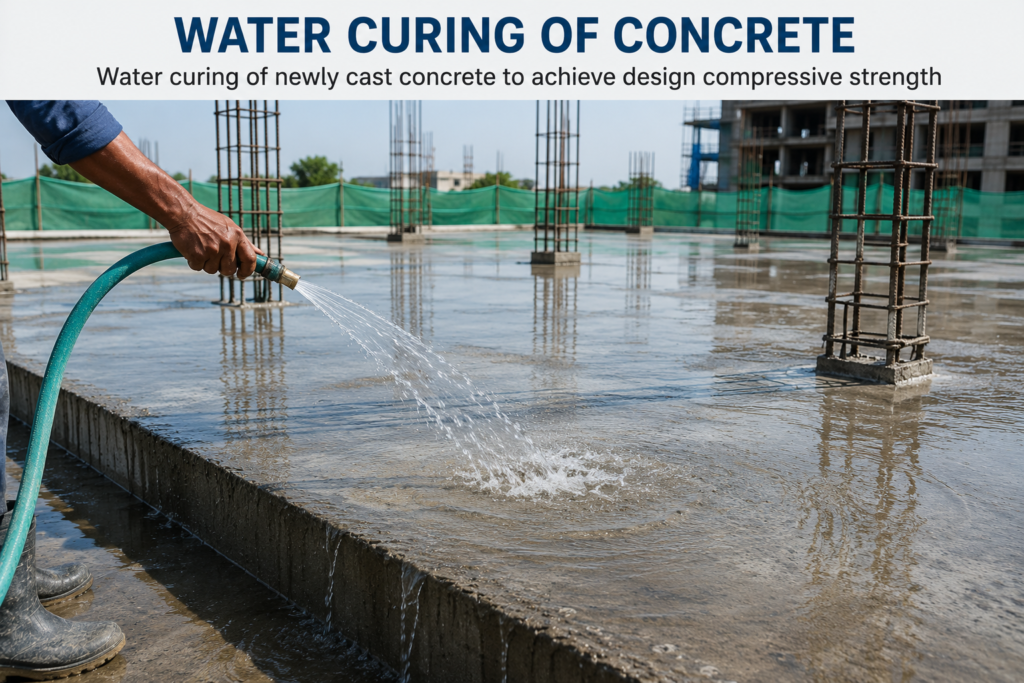
Curing
Proper curing for at least 7 to 14 days (and ideally 28 days) is essential for achieving the desired strength.
Recommended Water-Cement Ratio
| Grade | Water-Cement Ratio |
| M20 | 0.50–0.55 |
| M25 | 0.45–0.50 |
| M30 | 0.40–0.45 |
Workability of Concrete
Concrete should have sufficient workability for proper placement and compaction.
Typical slump values:
- Footings: 25–75 mm
- Beams: 50–100 mm
- Columns: 75–100 mm
- Pumped concrete: 100–150 mm
Curing Requirements
Concrete gains strength gradually.
Approximate strength gain:
| Days | Strength |
| 1 Day | 16% |
| 3 Days | 40% |
| 7 Days | 65% |
| 14 Days | 90% |
| 28 Days | 100% |
Which Concrete Grade Should You Choose?
Choose M20 if:
- Building an individual house
- Constructing boundary walls
- Residential slabs
- Small foundations
Choose M25 if:
- Multi-storey residential building
- Commercial complex
- Water tanks
- Heavy columns
- Parking structures
Choose M30 if:
- Industrial projects
- Bridges
- High-rise buildings
- Heavy machinery foundations
- Infrastructure works
Tips for Better Concrete Quality
- Use fresh cement from a reputable manufacturer.
- Ensure clean, well-graded sand and aggregates.
- Measure materials accurately instead of estimating by eye.
- Maintain the recommended water-cement ratio.
- Use mechanical mixers for medium and large projects.
- Compact concrete thoroughly with a vibrator.
- Begin curing as soon as the concrete has set and continue for the recommended duration.
- Avoid placing concrete during heavy rain or extreme heat without appropriate precautions.
- Follow the relevant Indian Standards such as IS 456, IS 10262, and IS 383.
Frequently Asked Questions (FAQs)
Is M20 good for house construction?
Yes. M20 is generally suitable for most residential RCC works, including slabs, beams, columns, and foundations, when designed and executed properly.
Is M25 stronger than M20?
Yes. M25 has a characteristic compressive strength of 25 MPa, making it stronger and more durable than M20.
Why is M30 used in commercial projects?
M30 offers higher strength, improved durability, and better resistance to environmental exposure, making it ideal for commercial and infrastructure applications.
Is M25 a nominal mix?
No. M25 is typically produced as a design mix to achieve the required strength and workability based on project-specific conditions.
Which concrete grade is best?
There is no single “best” grade. The right choice depends on the structural design, loading conditions, exposure environment, and project budget. M20 is adequate for many homes, M25 is common for larger residential and commercial buildings, and M30 is preferred for demanding structural and infrastructure projects.
Conclusion
Choosing the correct concrete grade is one of the most important decisions in any construction project. M20, M25, and M30 each serve different purposes based on their strength, durability, and intended applications.
For standard residential construction, M20 often provides an economical and reliable solution. M25 offers increased strength and durability for larger buildings and more demanding structural elements, while M30 is well suited to commercial, industrial, and infrastructure projects where higher performance is required.
Understanding the differences between these grades helps engineers, contractors, builders, and homeowners make informed decisions that improve safety, durability, and long-term value. Always follow structural design recommendations, use quality materials, and ensure proper mixing, placement, compaction, and curing to achieve the desired concrete performance.
- Responsibilities of a Site Engineer Explained: Roles, Duties, Skills, and Daily Work
- DeepLok PMC & Contracts Recruitment 2026
- PNC Infratech Ltd Recruitment 2026
- Types of Foundations in Building Construction | Complete Guide.
- Chavda Infra Ltd Recruitment 2026
- Bhilai Engineering & Consultancy Services Recruitment 2026
- Balajee Infratech & Constructions Recruitment 2026
- Difference Between OPC and PPC Cement
- Ahluwalia Contracts (India) Limited Recruitment 2026
- HG Infra Engineering Recruitment 2026